
To kick off the second quarter of A&S for Myrkfaelinn, I offer up this recipe from Forme of Curye:
From Gode Cookery: 73. Chyches. Take chiches and wrye hem in askes al nyght oþer al a day, oþer lay hem in hoot aymers. At morowe waische hem in clene water, and do hem ouere the fire with clene water. Seeþ hem vp and do þerto oyle, garlek hole, safroun, powdour fort and salt; seeþ it and messe it forth.
Chick peas: Take chick peas and cover them in ashes all night or all day, or lay them in hot embers. In the morning wash them in clean water, and do them over the fire with clean water. Seethe them up and do thereto oil, garlic whole, saffron, powder forte and salt. Seethe it and serve it forth.
In doing research on this I came across this lovely tidbit from the Company of the Staple* — and it’s an important tidbit:
In this text version and in this copy of the manuscript http://www.pbm.com/~lindahl/foc/FoC081small.html the comma in garlic hole safroun is between garlic and hole (garlic, hole saffron) indicating that it is the saffron which is whole, and the garlic may or may not be.
Here’s the aforementioned image:
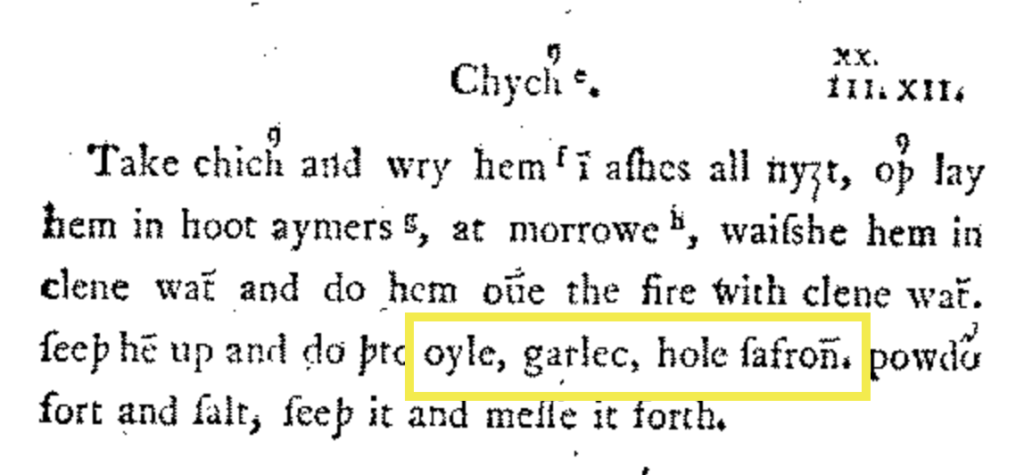 This fits in with my thinking that unless otherwise noted, saffron should be ground in medieval recipes, not used whole and steeped as is commonly done today.
Post your redactions and pictures if you try this recipe!
* The Company of the Staple is an Australian living history group focused on The Company of the Great Staple at Calais as it was in the year 1376.